
The relentless pursuit of high throughput, ultra-low latency, and massive connectivity in 6G and beyond wireless networks calls for a revolutionary paradigm shift in transceiver design. My research vision focuses on driving intelligence and computational capability directly into the electromagnetic (EM) and wave domains. By bridging advanced electromagnetic metamaterials with sophisticated mathematical signal processing and deep learning paradigms, my work aims to bypass traditional digital hardware bottlenecks, achieving speed-of-light processing and unprecedented spatial-spectral efficiency.
Below are the three pillars of my current research framework:
1. Stacked Intelligent Metasurfaces (SIM)
OverviewStacked Intelligent Metasurfaces (SIM) represent a major evolution from conventional single-layer reconfigurable intelligent surfaces (RIS). By physically cascading multiple programmable meta-atom layers, a SIM fundamentally shifts complex signal processing from the power-hungry digital baseband to the passive electromagnetic wave domain. This multi-layer architecture acts as an advanced analog computing engine capable of performing sophisticated high-dimensional programmable matrix-vector transformations, 2D discrete Fourier transforms, and multi-user transmit beamforming. Operating entirely in the wave domain at the speed of light, SIM radically reduces hardware costs, processing delays, and power consumption for next-generation MIMO transceivers. | 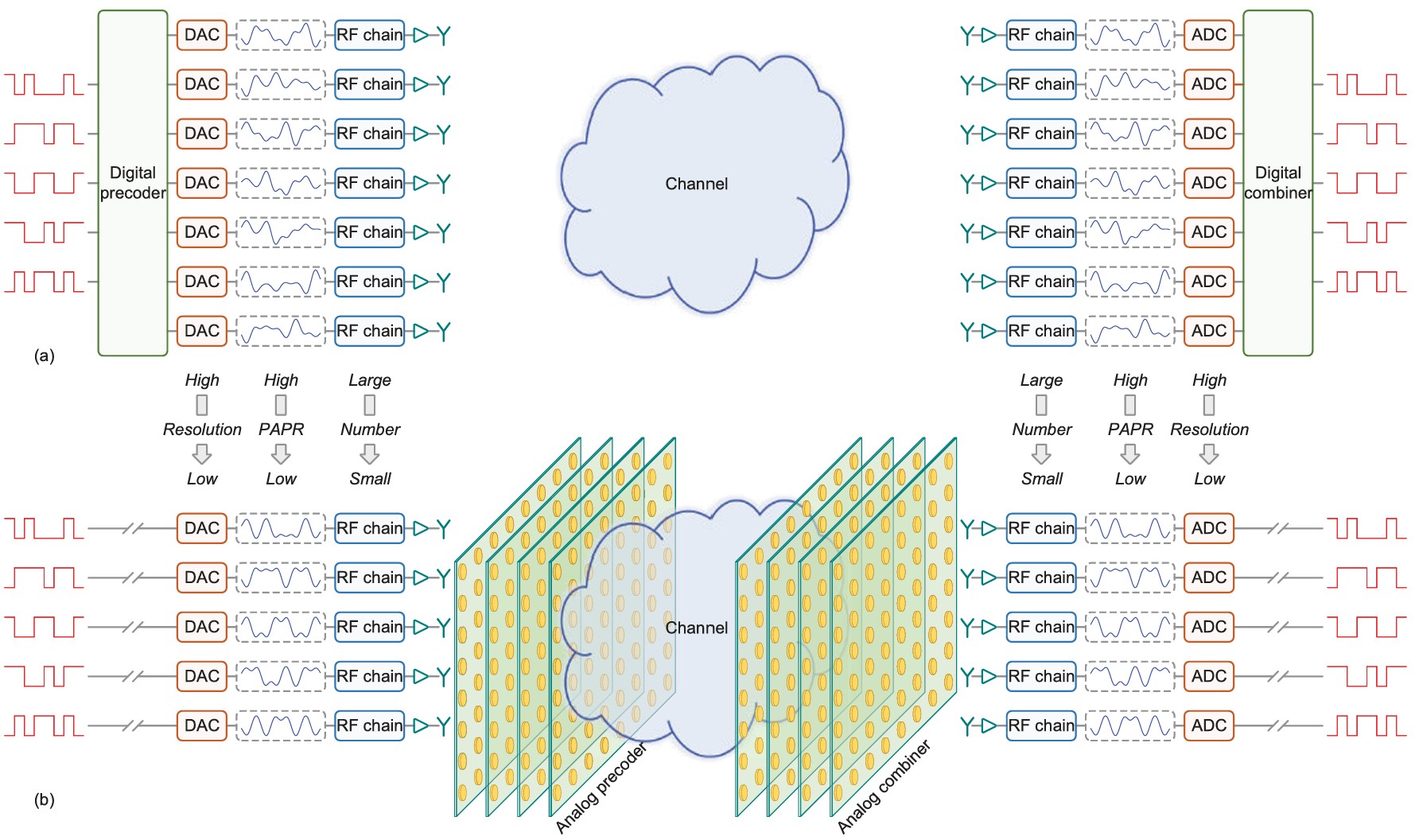 Wave-Domain Computing & Multi-layer Beamforming |
Selected Publications
- H. Liu, J. An, X. Jia, L. Gan, G. K. Karagiannidis, B. Clerckx, M. Bennis, M. Debbah, and T. J. Cui, “Stacked Intelligent Metasurfaces for Wireless Communications: Applications and Challenges,” IEEE Wireless Communications, vol. 32, no. 4, pp. 46-53, August 2025.
- J. An, et al., “Wave-Domain Signal Processing via Stacked Intelligent Metasurfaces for Multi-User MIMO Communications,” IEEE Transactions on Wireless Communications, (Under Review/In Press).
2. Flexible Intelligent Metasurfaces (FIM)
OverviewWhile traditional metasurfaces are confined to rigid geometries, Flexible Intelligent Metasurfaces (FIM)—often implemented in harmony with fluid/liquid antenna systems (FAS)—introduce a revolutionary degree of freedom: spatial reconfigurability. FIM consists of low-cost radiating elements capable of dynamically morphing their three-dimensional physical surface shapes, adapting element positions, or altering liquid profiles in real-time. This mechanical and electromagnetic flexibility unlocks a joint optimization space comprising phase-shift control and spatial position adjustments. FIM offers massive gains in multi-target wireless sensing, spectral efficiency, and multi-user tracking by dynamically tailoring the physical boundaries of the propagation environment. | 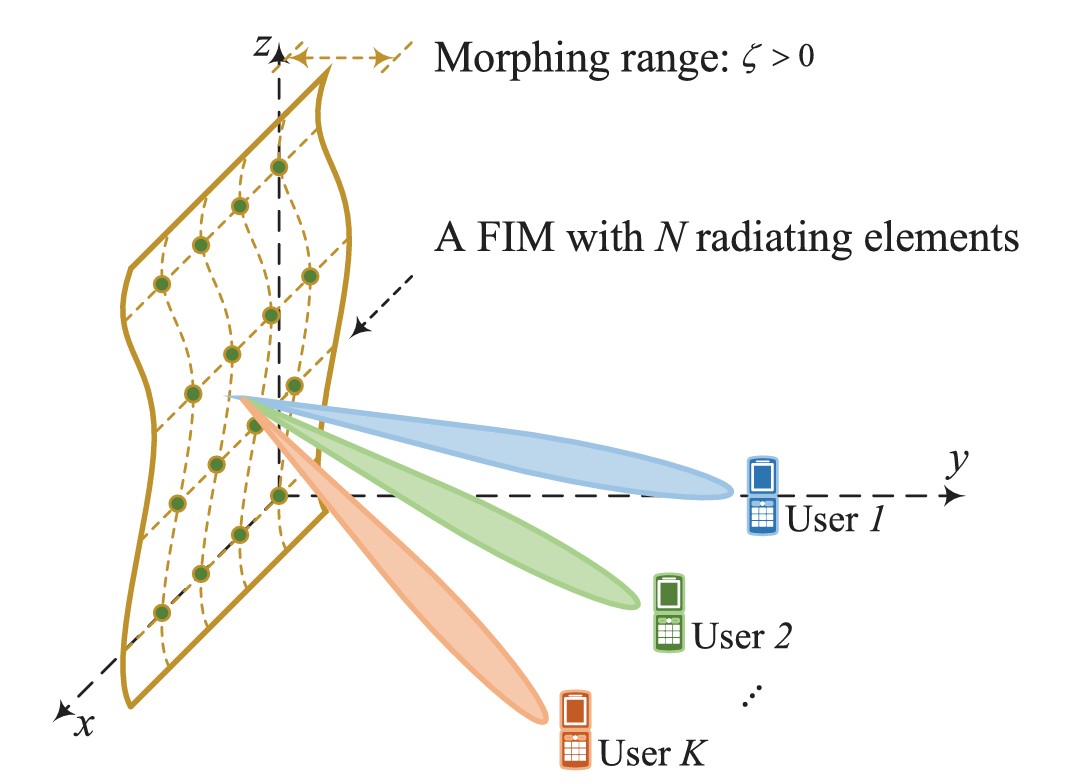 Spatial Degree-of-Freedom & Fluid Dynamics |
Selected Publications
- Z. Teng, J. An, L. Gan, N. Al-Dhahir, and Z. Han, “Flexible Intelligent Metasurface for Enhancing Multi-Target Wireless Sensing,” arXiv preprint arXiv:2506.23052, 2025.
- “Liquid Intelligent Metasurface for Fluid Antennas-Assisted Networks,” IEEE Wireless Communications Letters, vol. 14, no. 12, pp. 4192-4196, 2025.
3. Electromagnetic Neural Networks (EMNN)
OverviewElectromagnetic Neural Networks (EMNN) merge the structural principles of deep learning with wave-domain physics. By treating the programmable meta-atoms across multiple layers of a SIM as physical "EM neurons," the entire metasurface framework functions as a hardware-native artificial neural network. Instead of converting signals to digital bits for neural processing, EMNN uses the propagation, refraction, and interference of EM waves to execute forward-pass layer transformations naturally. This framework is highly potent for task-oriented semantic communications (SemCom), where semantic features of complex data (e.g., images) are encoded directly into physical custom waveforms at the transmitter and decoded via spatial power distributions at the receiver with near-zero computational latency. | 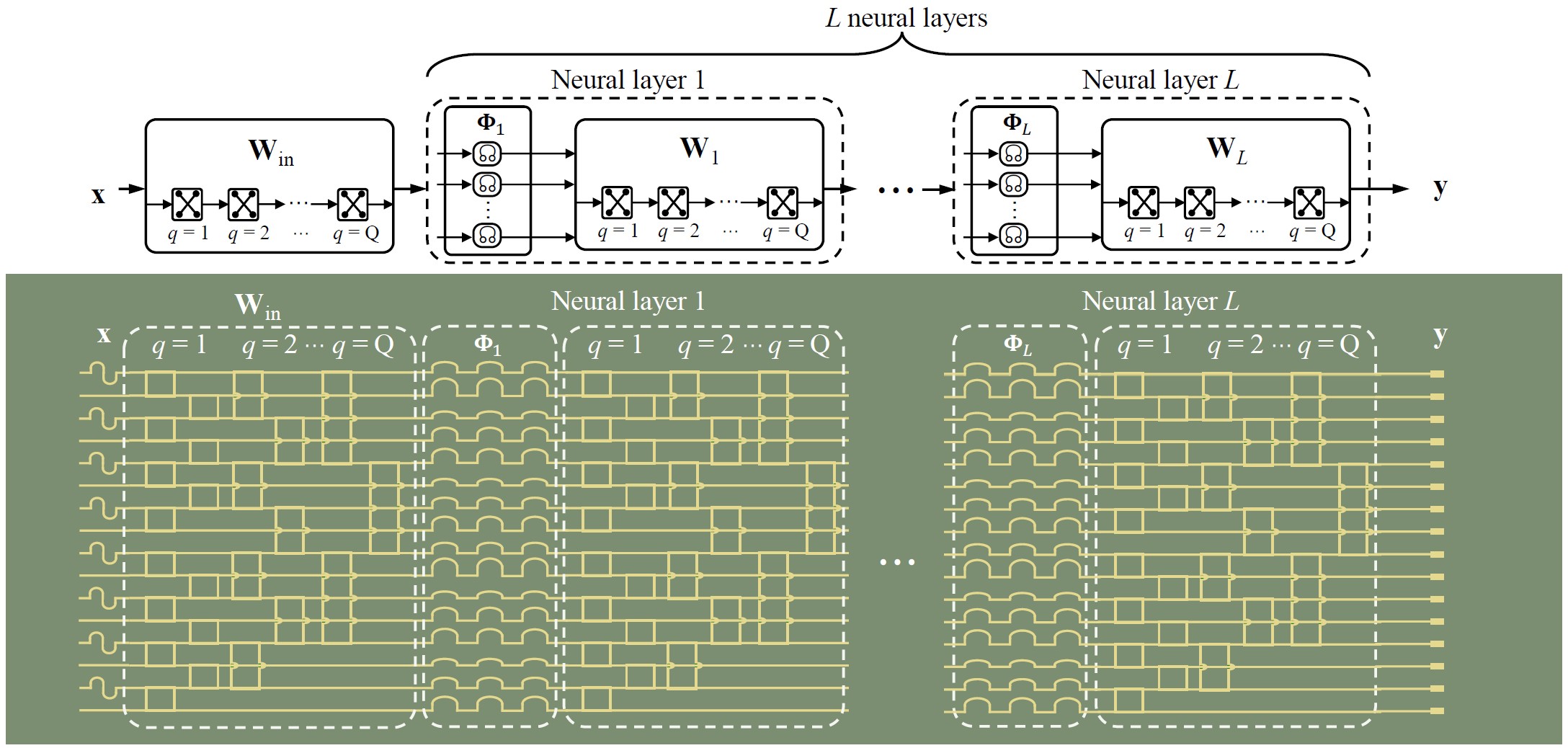 Task-Oriented Physical Inference & SemCom |
Selected Publications
- “Distributed Electromagnetic Neural Networks for Task-Oriented Semantic Communications,” arXiv preprint arXiv:2604.23901, 2026.
- “Harmonic Electromagnetic Neural Networks for Task-Oriented Semantic Communications,” ResearchGate Preprint, May 2026.